
First Look: A No-Frills Landing Page
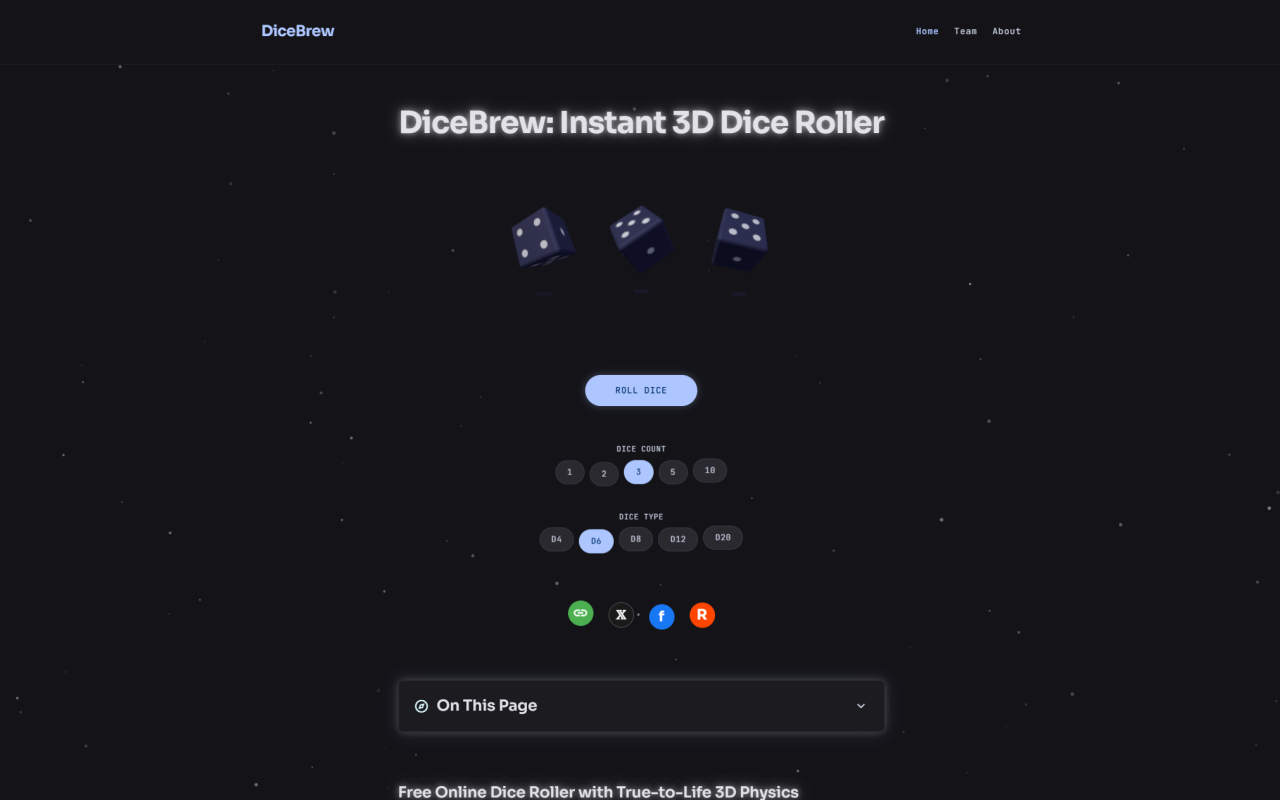
Upon visiting dicebrew.com, you are greeted by a clean, single-page web app that wastes no time. There is no splash screen, no register button, and no onboarding wizard telling you to rotate your device. The interface is sparse by design: a 3D dice tray dominates the center of the screen, with a control panel on the left offering dice count (1, 2, 3, 5, or 10) and dice type (D4, D6, D8, D12, D20). Below that sits a prominent "Roll Dice" button and a link-copy feature for sharing your roll results. The first thing you notice is how quickly it loads. The app is built entirely in WebGL and runs client-side, so there is zero wait time. On a modern smartphone, the page renders in under two seconds and the dice tray is immediately tappable. The background is a muted dark gray, and the dice themselves are rendered with soft, realistic shading. It is not trying to impress you with flashy menus—it gets straight to rolling.
Dice Selection and Rolling Mechanics
DiceBrew supports five polyhedral types: D4, D6, D8, D12, and D20. You can roll between 1 and 10 dice at a time, with preset quick-select buttons for common quantities. When testing the free plan (yes, it is entirely free), I threw five D20s at once and watched each one tumble and collide in real-time. The physics engine, developed by 345tool, simulates gravitational acceleration, object collision, and surface friction. The dice bounce off each other and off the walls of the virtual tray before settling. The results appear as numeric readouts above each die face after the roll settles. Notably absent are D10 and D100 options. This is a genuine gap for players of games like Vampire: The Masquerade or certain percentile-heavy board games. The tool also lacks a modifier input or a sum-total display for multi-die rolls—you have to add the numbers yourself. The interface keeps things simple to a fault in this regard.
Visuals and Physics: More Than a Gimmick
I was pleasantly surprised by the visual fidelity. The dice are not flat, low-poly objects—they have beveled edges, rounded corners, and reflective surfaces that catch the virtual lighting of the scene. The D4, in particular, is correctly rendered as a tetrahedron with readable numbers on each vertex. The D20 animates with a satisfying wobble before landing. At 60 frames per second on both desktop Chrome and Safari on an iPhone, the experience feels smooth and responsive. The physics engine adds genuine unpredictability. Because each die interacts physically with the tray and other dice, the outcome is influenced by chaotic, real-time variables like spin velocity and collision angle. This is not purely cosmetic—it contributes to the randomness of each roll. The only visual downside is the limited color palette. The dice appear in a default white body with black numbering, and there is no customization option for color, material, or inking. For a tool marketed as "photorealistic," the lack of personalization feels like a missed opportunity.
Privacy Architecture and Cryptographic Randomness
DiceBrew makes two claims that set it apart from most browser-based dice rollers: zero data collection and cryptographically secure randomness. Both hold up under scrutiny. The app runs 100% client-side, meaning the HTML, JavaScript, and WebGL assets are served as static files. No roll data is transmitted to any server. I verified this by opening the browser's developer tools and monitoring network activity while rolling—there were zero outbound requests during or after the roll. The random number generator uses the Web Crypto API's getRandomValues method, which is the same cryptographically secure standard used for encryption keys in browsers. This is a meaningful improvement over Math.random(), which uses a pseudo-random algorithm that can be seeded and predicted. In practice, this means each roll is mathematically unpredictable to the same standard as a hardware random number generator. For tournament play, remote RPG sessions, or any scenario where fairness is questioned, this provides verifiable integrity without needing a third-party witness.
Where DiceBrew Fits (and Where It Doesn't)
DiceBrew is an excellent tool for a specific audience: tabletop RPG players who want a quick, private, and fair digital roller without signing up for yet another service. It excels as a backup for physical dice that get left at home, as a primary roller for online D&D sessions where you want visual flair, or for games like Liar's Dice where you need to roll multiple six-siders behind a screen. The shareable link feature lets you copy the current dice configuration (type and count) to a URL, which is handy for sending to remote players. However, there are clear limitations beyond the missing D10 and D100. There is no support for multiplayer rolling, no persistent roll history or log, and no way to save custom roll presets (e.g., "3d8+2"). The tool is designed for immediate, session-by-session use—not for campaign tracking or character management. The price is right: it is completely free with no hidden tiers, no premium subscription, and no account required. Pricing details are not publicly listed on the website because there are none—the tool is available to everyone at no cost.
Final Thoughts
DiceBrew does one thing and does it well: it provides a visually impressive, mathematically fair, and privacy-respecting way to roll polyhedral dice in a browser. The absence of D10/D100 support and advanced roll features keeps it from being a universal replacement for a full-featured virtual tabletop, but as a free, instant-use utility, it is hard to fault. The client-side architecture and cryptographic RNG make it a trustworthy choice for anyone who cares about fair play and data privacy around the gaming table. If you need a quick, beautiful dice roll without the baggage of accounts or tracking, Visit DiceBrew at dicebrew.com to explore it yourself.


コメント